Mobility and muscle strengthening for people who sit all day
If your day starts at the office and ends in the same place, you are far from alone. Between working at the office, teleworking, back-to-back meetings, and time spent in front of screens, sitting has become a daily habit. As the hours pass, the body remains immobile, and gradually stiffness and discomfort set in.
The real problem is not sitting itself, but staying in the same position for too long without allowing the body to move.
This is where mobility work and muscle strengthening make all the difference. With simple, targeted exercises, you can loosen up your joints, stand straighter, and regain strength, even if you spend most of your day sitting down. It's not about intensive workouts or radical changes, but small, regular movements that help your body feel better, move better, and stay strong throughout the day.
How sitting all day can harm your health
A sedentary lifestyle does not damage the body overnight, but it gradually changes the way you move and function. Long hours of sitting keep the body in one position, which over time leads to stiff hips, weakened muscles, and poor posture. As movement decreases, the body becomes less efficient at doing what it is designed to do: standing, walking, and supporting itself properly.
An often overlooked problem is decreased muscle activation. The essential muscles in the hips, core, and upper back stop functioning properly, forcing other areas to compensate. This imbalance often explains the onset of daily pain without any apparent injury.
Many people feel:
- Persistent lower back pain
- Stiff hips and hamstrings
- Rounded shoulders and tension in the neck
- A decrease in energy and a general feeling of stiffness
Without regular breaks to move around, circulation slows down and joints become less lubricated, resulting in a feeling of heaviness and loss of mobility. Over time, the body adapts to sitting—and even simple movements can become uncomfortable.
The effects of prolonged sitting on the body
When you sit for long periods of time, certain muscles work less than they should. The muscles around the hips shorten, while those that support the lower back and abdominals weaken. This puts extra pressure on the back and can cause pain throughout the day.
Over time, the upper back becomes stiff and the shoulders slouch forward. These posture problems can increase fatigue, affect breathing, and put more strain on the joints. Without regular movement, simple actions such as standing up, walking, or stretching become more difficult.
What is mobility work and why do office workers need it?
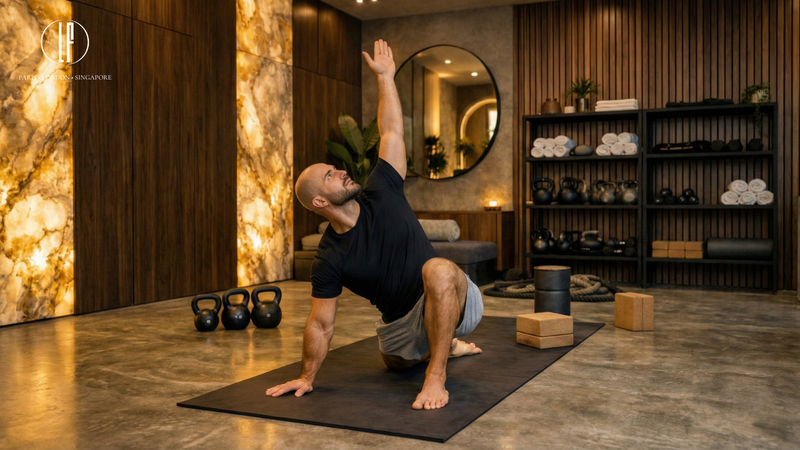
Mobility aims to allow the body to move more freely and comfortably. Unlike prolonged static stretching, it relies on gentle, controlled movements that keep joints active and reduce stiffness. The goal is simple: to help the body move the way it is supposed to.
.png)
For people who work in an office, mobility exercises are particularly useful because long hours of sitting limit movement. Regular practice helps to:
- Reduce stiffness associated with sitting
- Improve posture and balance
- Making muscle strengthening safer and more effective
- Reduce daily pain and tension
Even a few minutes a day can help you feel lighter and more comfortable during your workday.
Exercises to do if you sit all day
These exercises are simple and require no equipment. They can be done at home or at the office.
- Hip flexor stretch: Stand with your feet shoulder-width apart. Step back with one foot and gently bend the knee of the front leg. Keep your chest upright and hold for 20 to 30 seconds, then switch sides.
- Upper back rotations: Sit up straight, place one hand on the opposite knee, and slowly rotate your torso to one side. Hold for a few seconds, return to the center, then switch sides.
- Neck mobility circles: While sitting or standing, slowly move your head in circles in a controlled manner. Repeat a few times in each direction.
- Ankle mobility: While seated, lift one foot slightly and make small circles with your ankle. Change direction and then switch feet.
When performed daily, these exercises reduce stiffness caused by long hours of sitting.
Upper body exercises for office workers
.png)
Long hours at the desk can lead to rounded shoulders and neck tension. These simple exercises strengthen the upper body:
- Wall push-ups: Face the wall, hands shoulder-width apart. Bend your elbows to bring your chest closer to the wall, then push back. 10 to 15 repetitions.
- Elastic band pull: Sitting or standing, pull the band toward your chest while squeezing your shoulder blades together, then slowly release. 10 to 15 repetitions.
- Shoulder extensions leaning on a desk: Sit up straight, place your hands on the edge of the desk, push your body up slightly by extending your arms, then lower yourself back down.Repeat 10 to 12 times.
- Squeezing the shoulder blades: Standing or sitting upright, squeeze your shoulder blades together for 3 to 5 seconds, then release. Repeat 10 times.
Lower body exercises
Sitting weakens the hips, glutes, and legs.
- Chair squats: Stand in front of a chair with your feet hip-width apart, lower yourself as if you were going to sit down, then stand back up. Repeat 10 to 15 times.
- Back lunges: Step back with one foot and bend both knees. Return to the starting position and switch legs. 8 to 10 repetitions per side.
- Glute bridge: Lie on your back with your knees bent, lift your hips by contracting your glutes, then lower yourself back down. 12 to 15 repetitions.
- On your toes: Stand up, lift your heels, hold for one second, then lower them. Repeat 15 to 20 times.
Core exercises at the office
A weak core promotes lower back pain.
- Seated knee lifts: Sit upright, lift one knee toward your chest, then switch sides. 10 to 12 repetitions per side.
- Standing core exercise: Contract your abdominal muscles as if to absorb a blow, hold for 10 seconds. 5 to 8 repetitions.
- Plank on desk: Hands on the desk, body aligned, hold for 20 to 30 seconds.
- Slow torso rotations: Gently rotate your upper body to each side. 10 repetitions per side.
Micro-sessions (3 to 5 minutes)
- 30 seconds of squats
- 30 seconds of shoulder rotations
- 30 seconds of lunges
- 1 minute of stretching
These mini-sessions reduce stiffness and maintain energy levels.
Simple daily routine
.png)
Consistency is key. A simple routine can be organized as follows:
Morning: 5 minutes of mobility exercises to loosen up your joints
Midday: a 3-5 minute strength training circuit (upper body, lower body, core)
Afternoon: a few quick movements focused on posture
Evening: light stretching to release tension
Short, regular sessions are much more effective than occasional long sessions.
Common mistakes to avoid at the office
To maximize benefits and minimize the risk of injury:
- Don't just stretch: combine mobility and strengthening
- Pay attention to your posture during the exercises.
- Avoid doing too much, too quickly.
- Give your body recovery days
The balance between mobility and strengthening helps keep your body strong, flexible, and comfortable, even after long hours of sitting.
How often should you practice?
When you sit all day, it's the small, regular movements that make the difference—much more so than long, infrequent workouts.
Mobility: ideally every day, even a few minutes are enough to keep joints flexible and reduce stiffness.
Muscle strengthening: 3 to 4 times a week to reactivate weakened muscles and support posture.
Even short sessions have a real impact. The key is consistency. A few minutes each day can help you move better, reduce pain, and make long days spent sitting much more bearable.
Staying fit even when sitting all day
Sitting all day doesn't mean you have to put up with stiffness, pain, or poor posture. By combining mobility, muscle strengthening, and regular active breaks, you can stay strong, mobile, and comfortable, even during long workdays.
It's the small changes, applied consistently, that really transform your well-being. Move regularly, move smartly—your body will thank you for it.
If you would like some support, I can help you. As a sports coach, I support active professionals like you, using simple, effective methods that are tailored to a sedentary lifestyle. Together, we can build a routine that fits in with your schedule, strengthen your body in the long term, and help you feel your best, without spending hours at the gym.