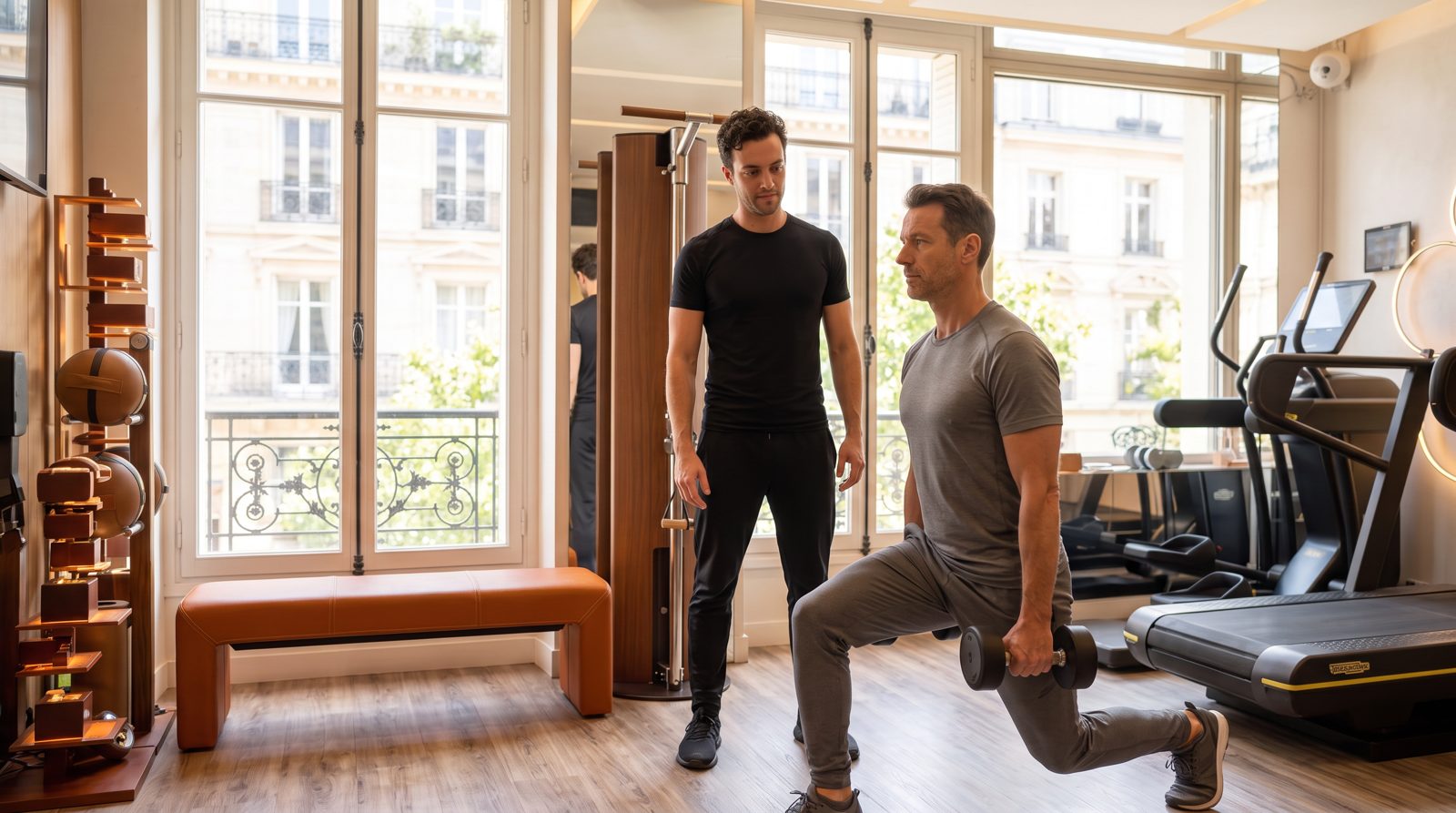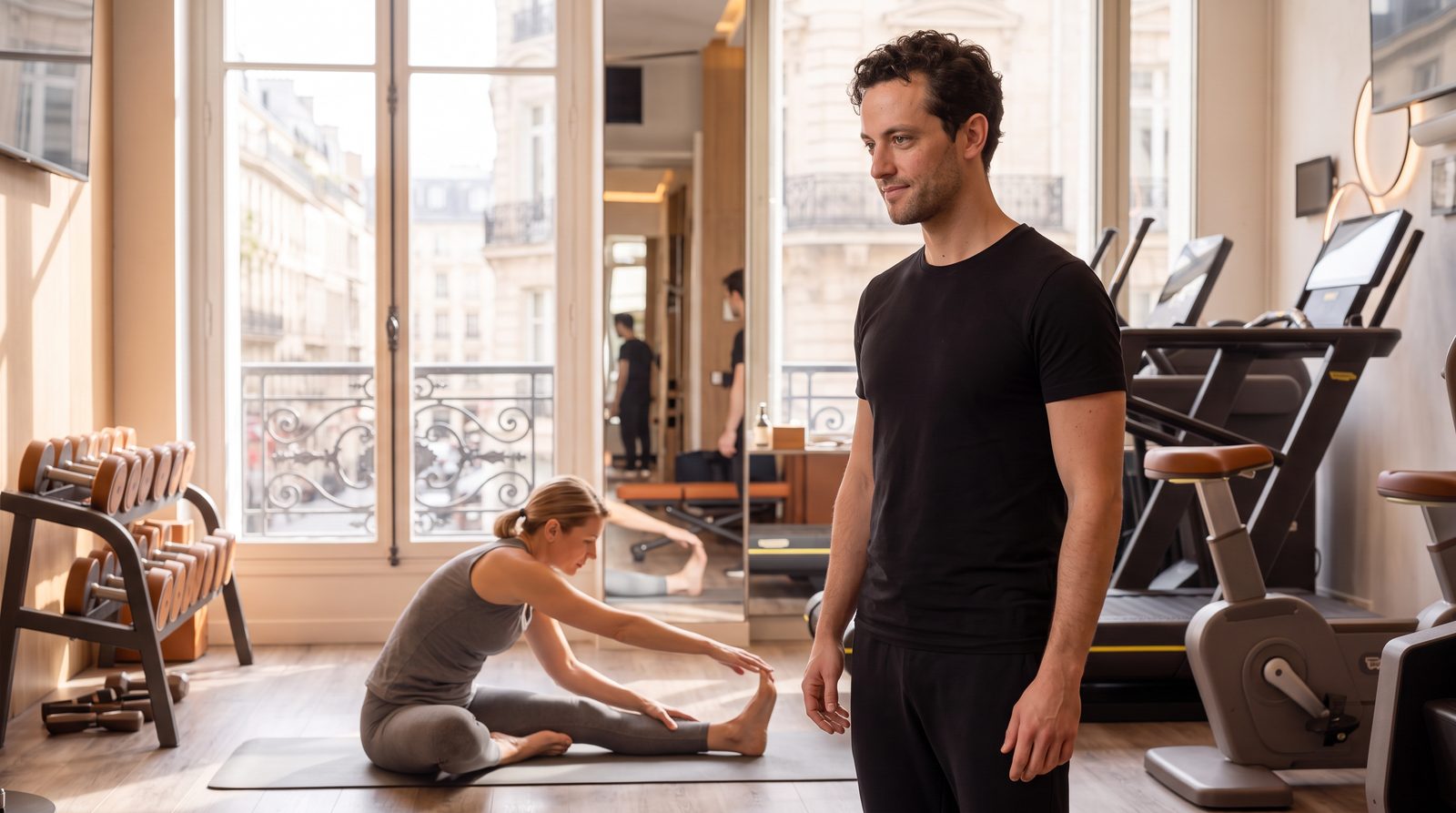
Improving flexibility doesn’t take much time, but it does require consistency, proper technique, and choosing the right time of week. A few minutes of targeted stretching for each muscle group, several times a week, are better than one long, occasional session. The hardest part isn’t knowing what to do—it’s finding the right intensity, choosing the right exercises for your body, and sticking with it over the long term. That’s exactly what a personal trainer works out with you: in Paris, at Louis Fabre Coaching, we start with your body, your lifestyle, and your goals—not with a generic program.
Here is the step-by-step method, along with what medical and scientific sources say.
Why We Lack Flexibility
Flexibility is not a single quality. It combines joint mobility (limited by the bones, joint capsule, and ligaments) and muscle elasticity (limited by the connective tissues surrounding it). What you perceive as stiffness may stem from one, the other, or both.
Several factors come into play. The structure of your joints and connective tissues, your age, your gender, your muscle mass, past injuries, and your level of physical activity all affect your range of motion. A sedentary lifestyle, with long hours of sitting, does the rest: tissue that isn’t used to its full range of motion adapts accordingly.
The stakes go beyond comfort. According to Inserm, losing flexibility increases the risk of joint pain and muscle injuries, and the benefits of good flexibility apply to everyone, regardless of athletic ability. Whether you’re an executive who spends your days in meetings or a marathon runner, the logic is the same: regaining range of motion frees up movement and protects your body.
How long and how often
Good news: the sessions are short. A meta-analysis of 189 studies involving more than 6,500 adults, reported by The Conversation, indicates that about 4 minutes of static stretching in a single session is enough to produce immediate improvement, and that 10 minutes per week for each targeted muscle maximizes long-term progress.
As for official recommendations, the Health Insurance Agency advises adults to do flexibility exercises (yoga, tai chi, stretching) at least two to three times a week. For those 65 and older, it recommends at least 10 minutes, twice a week.
A concrete example for an active adult with very tight hamstrings (the back of the thighs):
- 3 sessions per week, lasting 10 to 15 minutes;
- 2 or 3 target muscles per session, no more;
- 2 holds of 30 seconds per muscle, for a total of about 1 minute of effective work for each;
- Only one variable is changed at a time (either the duration or the number of passes), never both.
You’ll start to see results after a few weeks of regular practice. Ambitious goals, such as placing your hands flat on the floor with your legs straight, take several months to achieve. The time it takes varies greatly from person to person, depending on your starting point, age, and consistency.
How to Stretch When You're Very Stiff
Stiffness isn’t inevitable in adulthood. Even after age 60 or 70, it’s still entirely possible to improve flexibility with a gradual approach: warm-up, holding each stretch for 20 to 30 seconds, 10 to 15 minutes a day, and consulting a professional if you experience acute pain. We’ve dedicated an article to fitness coaching for seniors.
A reasonable four-step process:
- Start small. 10 minutes, three times the first week. The goal is to be able to do it again the next day without any discomfort.
- Aim for moderate tension. You should feel the stretch, not feel pain from it. If you experience sharp pain, numbness, or weakness, stop.
- Change one variable at a time. Take a few extra seconds, or do one more round, and then wait one to two weeks before making a judgment.
- Look for the true signs of progress: reduced tension over the same period of time, fewer compensatory movements (such as rounding the back or bending the knee), and feeling normal the next day.
If you have persistent pain, a known joint condition, or a recent injury, consult your doctor or a physical therapist before you begin.
When to Stretch, and When to Skip It
This is the most common mistake: stretching at the wrong time.
Before exercising. Passive stretching (holding a position without moving) right before exercise is not recommended: it can reduce performance and increase the risk of injury. Before your workout, it’s better to do a dynamic warm-up. We describe our routine in detail in “10-Minute Warm-Up Before Your Workout.”
Immediately after exercise. Here, we need to qualify that statement. According to Inserm, stretching is not a recovery tool and does not reduce muscle soreness; if done too intensely right after exercise, it can even exacerbate microtears in the muscles. If the goal is to increase flexibility, it’s better to do a separate stretching session two hours after exercising or the next day, holding each stretch for 30 seconds to one minute.
Physical therapists interviewed by L’Équipe offer a simple guideline: 12 hours after exercise if there is no muscle soreness, and 24 to 48 hours if there is.
The rest of the time. A dedicated session, a day without intense training, a quiet moment in the evening: that’s the perfect time to make progress.
Techniques That Work
Static Stretching
Hold the position slowly, breathing steadily, without bouncing. For adults, holding the position for 20 to 30 seconds is a good starting point; Dr. Denys Barrault, a sports medicine physician, recommends holding the position without bouncing after warming up. Aim for moderate tension—never sharp pain.
The contract-relax method
The PNF technique involves stretching the muscle, contracting it for a few seconds against resistance, relaxing, and then stretching it a little further. Dr. Hervé de Labareyre considers it preferable to simple passive stretching, whereas ballistic (bouncing) stretches are not recommended due to the risk of injury. This is a technique where having someone else watch makes all the difference: the intensity of the contraction and the timing of the release are best judged by two people working together.
Dynamic Work
Wide, controlled movements (lunges with rotation, controlled leg swings, hip circles) maintain joint mobility and prepare the body for physical exertion. This is the foundation of our mobility coaching program in Paris.

Strengthening in the amplitude
Gaining flexibility without strength within a new range of motion means gaining a freedom that the body cannot control. That is why Pilates, which combines stretching and strengthening, is of interest to sports medicine doctors.
Yoga, Pilates, stretching: Which one should you choose?
All three work, and the right choice depends on what you're looking for.
- Stretching. Targeted range-of-motion improvement, muscle by muscle. For specific areas of tightness (hamstrings, hips, shoulders).
- Yoga. Flexibility, breathing, proprioception, relaxation. To combine mobility and stress management.
- Pilates. A combination of stretching and deep strengthening. For stable, controlled range of motion.
- Dynamic mobility. Range of motion for athletic activities. For athletes and runners.
Yoga deserves a mention: the Order of Massage Therapists and Physical Therapists notes that it improves flexibility, proprioception, and breathing. To practice it safely, it recommends seeking guidance from professionals and consulting your doctor or physical therapist if you have any medical conditions. Inversion poses, in particular, require qualified supervision. A gentle sequence on your rest day fits very well into a week of training, but it should be planned as a workout, not as a bonus.
Mistakes That Hinder Progress
- Push yourself until it hurts. A slight tension is helpful; sharp pain is a sign to stop.
- Rebound. The rebound triggers a protective reflex in the muscle, causing it to contract rather than stretch.
- Stretch before exercising. Start with a few dynamic movements, then move on to the flexibility routine.
- Focus only on the muscle that is pulling. A stiff hip is often caused by a lack of strength or control elsewhere.
- Forget about consistency. Ten minutes three times a week is better than one hour every two weeks.
- Stretching without guidance. According to Inserm, only 37% of the athletes surveyed said they had been supervised while stretching.
How a Coach Can Help Improve Your Flexibility
This last point is at the heart of the matter. Inserm recommends seeking advice from a professional to learn the proper intensity, technique, and form based on your goals. That’s exactly where a personal trainer comes in: they identify compensations you aren’t aware of, fine-tune your form down to the millimeter, choose the technique best suited to your flexibility, and tailor the sequence of exercises to your weekly training schedule.
At Louis Fabre Coaching, our personalized assessment serves as a starting point. It helps us identify where you’re losing range of motion before we develop a plan. Sessions are tailored in real time to your current level and your specific needs for the day.
Our Perspective
When a client tells us, “I’m stiff,” we always ask the same question: Where are you stiff, and how long has it been going on? A shoulder that’s stiff from working at a computer isn’t treated the same way as hips that have become tight from years of running.
We believe that flexibility is built through strength and control. That’s why our sessions combine mobility, strength training, breathing exercises, and—depending on your goals—yoga or Pilates. Each session is tailored in real time to the body we’re working with that day.
We also work with executives, athletes, and people who simply want to move better. What they have in common is that they make progress when someone adjusts, corrects, and encourages them at just the right moment.
Moving from Theory to Your Program
If you’re looking for a flexibility program tailored to your needs—whether in Paris, at a studio, or in the comfort of your own home—our team offers personal training, group classes, and in-home sessions, as well as packages of 10, 20, or 30 sessions. Start with a personalized assessment to identify your priorities, or explore our full range of coaching services.
We also offer classes in London and Singapore, and our programs include fitness, Pilates, and strength training.
Frequently Asked Questions
How can you improve your flexibility quickly?
The first signs of progress appear after a few weeks of regular practice, at a rate of two to three sessions per week. Research reported by The Conversation shows that about 4 minutes of static stretching can immediately improve range of motion. For long-term results, consistency matters more than intensity.
What sport should you do to improve your flexibility?
Yoga, Pilates, and stretching are all good options. Stretching targets a specific muscle; yoga combines flexibility and breathing; and Pilates adds strength training. The right choice depends on your flexibility, your goal, and your athletic activities, and a coach can help you decide.
Should you stretch after exercising to aid recovery?
According to Inserm, stretching is not a recovery tool and does not reduce muscle soreness. To improve your range of motion, make it a separate session, a few hours after your workout or the next day. When it comes to recovery, sleep remains the most important factor.
Are you too old to become more flexible?
No. A sports medicine doctor quoted in Santé Magazine says it is entirely possible to improve flexibility after age 60 or 70, provided you progress gradually, warm up, and exercise for 10 to 15 minutes a day. If you experience acute pain, consult a doctor.
Is a coach helpful when working on flexibility?
Yes, especially if you’re looking to make specific progress: it adjusts the intensity, technique, and form—all of which Inserm recommends learning from a professional. It also builds a progression over several weeks around your other workouts.
Sources
- How Can You Become More Flexible? (Causes of Lack of Flexibility)
- Stretching Properly to Combat Muscle Soreness—Really… (Santé.fr, Inserm)
- Why and How Should You Improve Your Flexibility? (The Conversation)
- Adults and Seniors: Physical Activity for Every Age Group (Ameli)
- A warm-up is better than passive stretching before exercising (franceinfo)
- What if we've been completely wrong about stretching? (L’Équipe)
- The Best Stretching Exercises for Seniors (Santé Magazine)
- Stretching: From Common Misconceptions to Experimental Data (Sports Medicine)
- What are the best exercises for improving flexibility? (Allo Docteurs)
- Yoga: Between Myth and Reality (Order of Massage Therapists and Physical Therapists)