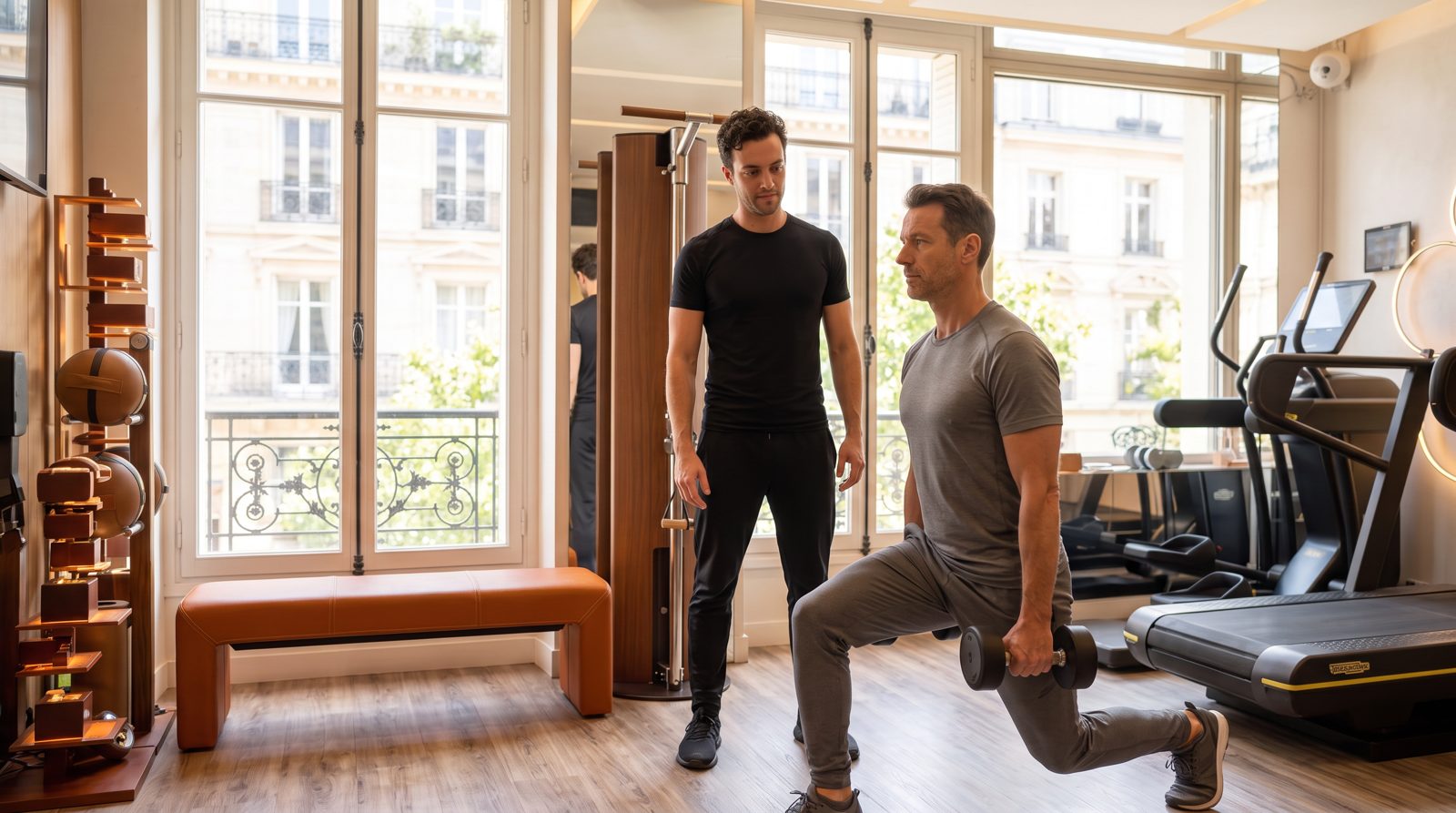
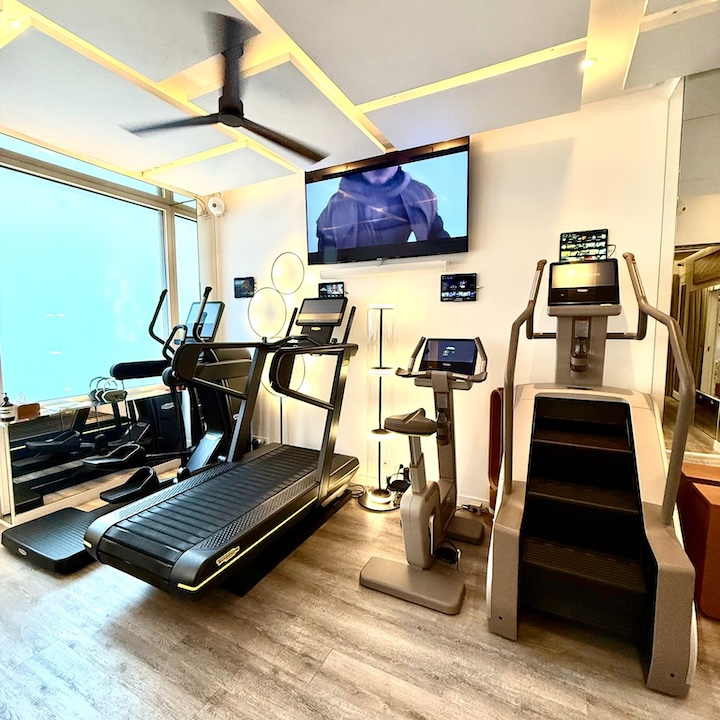
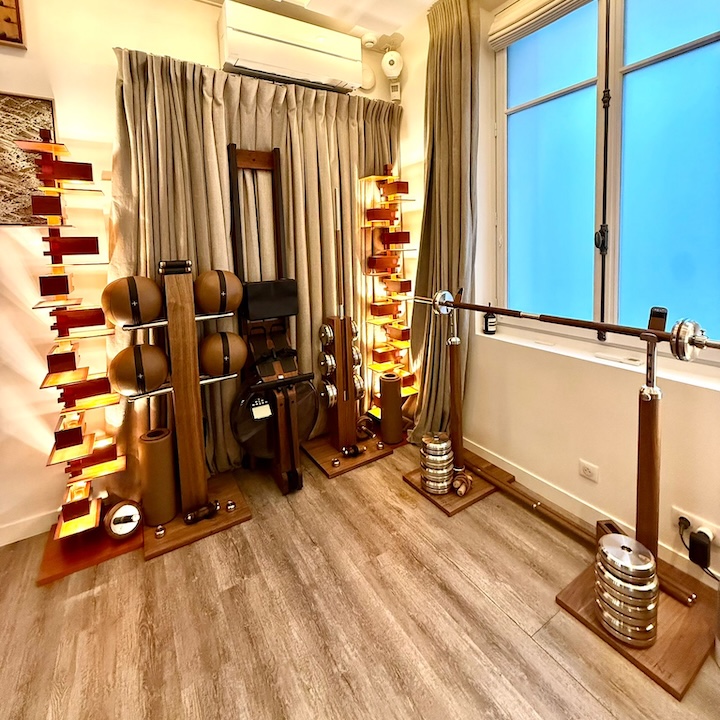
In London, you waste time commuting long before your workout even begins. A personal trainer who comes to your home eliminates that commute—and, most importantly, that excuse: the session takes place at your home, at a time that fits your schedule, with a program tailored to your body and your daily routine. At Louis Fabre Coaching, we work with clients in Paris, London, and Singapore, offering individual, partner, group, or in-home sessions. Here’s how to choose your coach in London, what a proper session should include, how much this service costs, and what to check before you start.
Why Working Out at Home in London Is a Game-Changer
The first advantage is logistical. Between a meeting in the City, a Tube ride from Kensington or Canary Wharf, and a crowded gym at 6 p.m., a 45-minute workout can easily take up two hours. When the main obstacle is organization rather than motivation, working out at home solves the problem at its root: you don’t have to travel, you don’t have to adjust to a gym schedule—you just work out.
The second benefit is precision. With just you and your coach, you don’t have to wait for any machines, and you aren’t following a generic workout plan. Each exercise is chosen specifically for you, corrected in real time, and adjusted based on how you’re feeling that day: a short night’s sleep after a flight back from New York isn’t treated the same way as a quiet week.
The third is consistency. A regular appointment with someone who’s waiting for you is more sustainable than a gym membership. That’s what makes the difference between three weeks of enthusiasm and a lasting transformation.
This format is suitable for four types of people we regularly encounter:
- individuals who want to get back into shape, improve their posture, or get back into exercise after a long break;
- executives whose schedules leave no room for downtime and who are seeking energy and peak performance;
- athletes training for a marathon or a tennis season;
- people looking for lasting physical transformation, weight loss, or muscle gain.
Goals, Formats, and Home Activities
Almost all fitness goals can be worked on at home, provided the coach provides the right methods and equipment.
Fitness, Posture, and Strength Training
This is the essence of in-home coaching: getting back into exercise after a long break, correcting poor posture caused by desk work, and strengthening the back, hips, and shoulders. These goals primarily require a good mix of mobility, core stability, and strength training—all of which can be easily achieved in a living room with just a few pieces of equipment.
Weight Loss and Muscle Gain
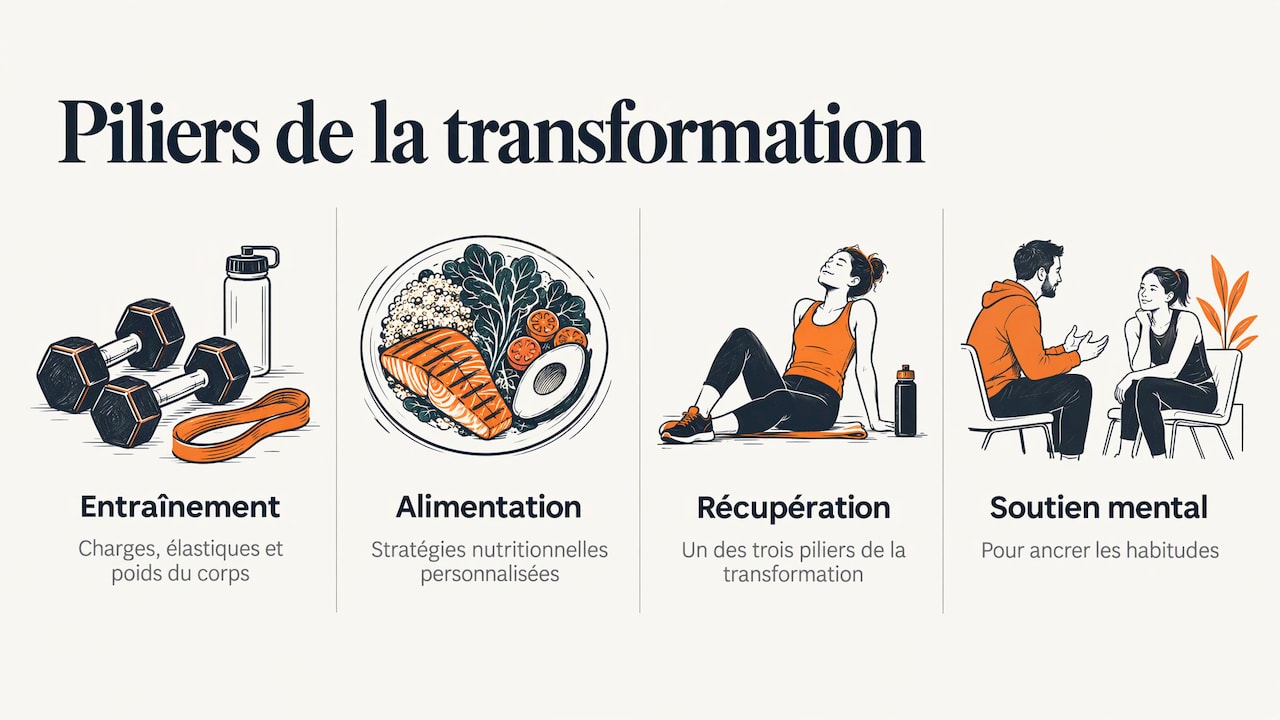
Body transformation is based on three pillars: progressive training, a consistent diet, and recovery. Our weight-loss program combines these elements, and our method incorporates personalized nutritional strategies as well as mental support, because visible results are only sustainable if they’re backed by lasting habits. For strength training, the at-home workout combines free weights, resistance bands, and bodyweight exercises.
Athletic Training
For marathon training, home serves as the base: strength training, mobility exercises, injury prevention, core work, and strength training specific to running. Long runs take place outdoors—in Hyde Park, along the banks of the Thames, or in Regent’s Park—and the coach builds the entire training plan around them. We also offer one-on-one tennis lessons for players who want to improve their technique.
Available formats and disciplines
A good coach does more than just strength training. At Louis Fabre Coaching, the programs cover strength training, muscle building, weight loss, mobility, Pilates, yoga, HIIT, boxing, and running training.
When it comes to format, you have a choice:
- One-on-one session: for a specific goal and a tight schedule; the coach’s full attention, with real-time adjustments.
- Duo: For couples, friends, or coworkers; shared motivation, a session tailored to both skill levels.
- Group Coaching : for a small group or a team; collective energy, with the same program tailored to different skill levels.
- Private in-home coaching: for all fitness levels; no commute, sessions in the comfort of your own home.
A practical note: the space required is minimal. Two to three square meters of open space is sufficient for most sessions, and a garden, a patio, or a building lobby can be used when the weather permits.
How a Session Unfolds, Step by Step
A well-structured at-home workout follows a specific sequence. Here is the outline we recommend.
- The Initial Assessment. We start with a comprehensive review: medical history, injuries, lifestyle, goals, stress levels, and sleep. Our personalized assessment provides an objective starting point for developing your training plan.
- Dynamic warm-up. Joint mobility, muscle activation, gradual increase in heart rate. That’s the difference between starting cold and starting ready.
- The main set. Strength, cardio, mobility, or technique, depending on your goal. The coach adjusts the load, pace, and rest periods while observing your form.
- Real-time adaptation. This is at the heart of our method: the session adjusts based on your energy level, your breathing, and the quality of your movements, ensuring optimal progress without overexertion.
- Winding down and taking stock. Stretching, breathing exercises, then a review: what went well, what will change next time, and what nutritional tips to follow in the meantime.
At every stage, a coach’s value lies in their ability to spot and correct things you can’t see on your own: a knee that caves in, a hunched back, or restricted breathing. A program you find online doesn’t do that.
Recovery and Nutrition: What Helps You Maintain Your Results
A workout is only part of the process. Progress is made between workouts—through sleep, nutrition, and recovery.
That’s why our coaching includes personalized nutritional guidance and advice on micronutrients. For very long workouts, the same principles apply: hydration, appropriate meals, sleep, and a gradual return to training.
Mentally speaking, a leader or athlete under pressure benefits from treating energy, stress, and motivation as components of the program. Our wellness program does just that.
How much does a personal trainer cost in London?
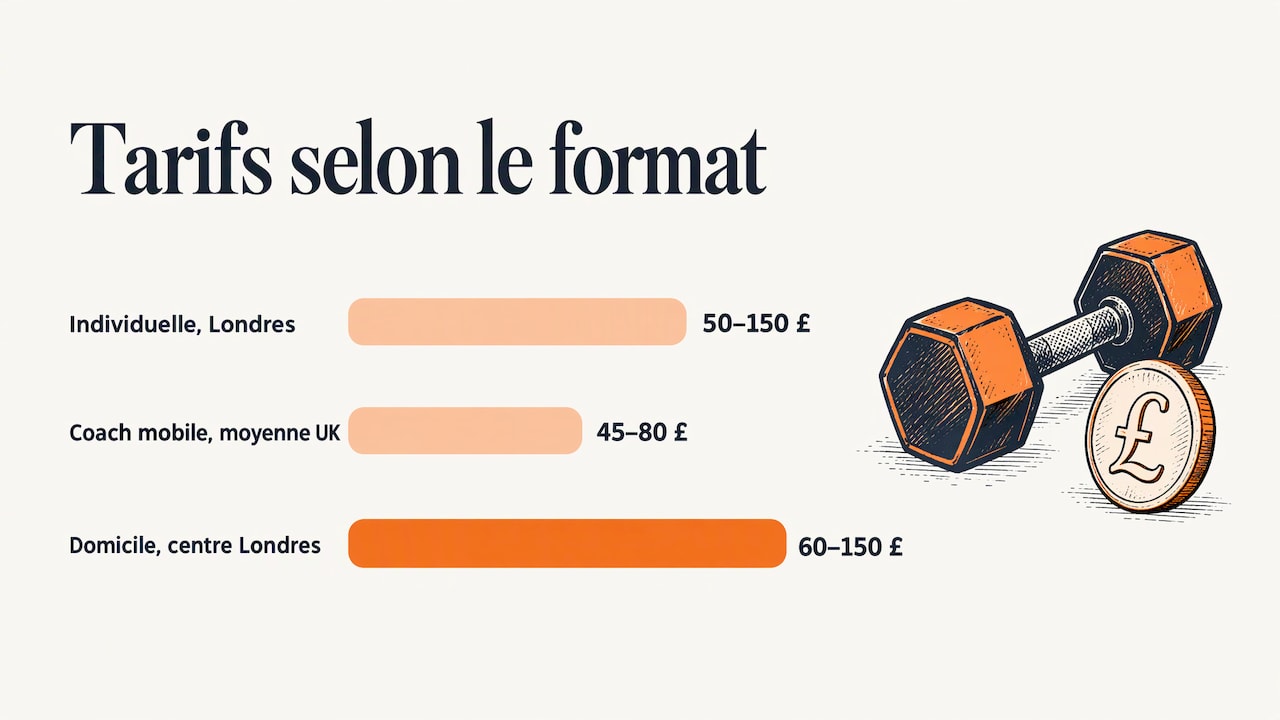
Rates in London vary widely. According to a 2026 comparison of personal trainer prices in the United Kingdom, a one-on-one session in London generally ranges from £50 to £150, while mobile trainers charge between £45 and £80 on average nationwide. The same report indicates that in central London, the price range for a one-hour in-home session ranges from £60 to £150. These are market benchmarks, not our studio’s prices.
Three factors account for the discrepancy:
- Neighborhoods like Mayfair, Chelsea, or Knightsbridge aren't charged at the same rate as the outer suburbs, mainly because of travel time;
- Duration and frequency: Two sessions per week for three months cost less per session than a single session, thanks to package deals;
- The content: A coach who incorporates nutrition, mental coaching, assessment, and recovery does not provide the same service as a simple hour of exercise.
At our studio, reservations and payments are made online, either per session or in packages of 10, 20, or 30 sessions. Prices are not listed on the website: they depend on your goals and the package you choose, and can be found on the Services page.
Qualifications, Insurance, and Precautions: What You Need to Know in the United Kingdom
One thing that often surprises readers from France is that the United Kingdom does not require a professional license for sports coaches. A British business advisory document notes that no qualification is legally required to practice, even though training, first aid, and an understanding of health and safety are expected in practice. A coach’s competence is therefore judged based on their experience, not on a mandated credential.
Before you begin, review the following points:
- Your background: recognized degrees, continuing education, and experience working with people whose profiles are similar to yours.
- First aid: A personal trainer who works in your home must know how to respond on their own in case someone becomes ill.
- Insurance: A British guide recommends verifying that the policy covers the client’s home, public spaces, transported equipment, and the activities actually offered.
- Your health: If you have a heart condition, persistent pain, are pregnant, or are currently undergoing treatment, talk to your primary care physician (or your GP in London) first, then share the information with your coach.
- Practical details: session length, cancellation policy, equipment to bring, and space required in your home.
The British sector is now organized around the professional body CIMSPA, which took over the directory of exercise professionals after the REPs registry was discontinued in 2020.
Our Approach and Services in London
Why We Believe in In-Home Coaching
We began our coaching with a simple belief: the body is never the same from one day to the next, so a rigid program can’t be the right one. What sets us apart is real-time adaptation: we observe, we adjust, and the session evolves as we go.
In London, Paris, and Singapore, our clients have busy schedules. Working from home gives them back time and a sense of true privacy while they work. We combine this with nutrition, mental support, and high-quality equipment, because lasting transformation requires a holistic approach that addresses both body and mind.
The best coach isn't the one who promises the fastest results, but the one who works with you to establish a routine that you'll be able to maintain for years to come. That's the essence of our method.
If you're looking for a comprehensive fitness program, we start with a personalized assessment, then we'll design your program: personal training, private in-home sessions, partner workouts, or group classes, with packages of 10, 20, or 30 sessions. You can find all our options on our services page.
Do you live or travel elsewhere as well? We offer our services in Paris and Singapore, and we’ve explained how it works in Singapore in our article on in-home personal training in Singapore.
Getting Off to a Good Start: A Plan for the First Four Weeks
To ensure that coaching is effective, here is a realistic framework.
- Week 1: Assessment, setting a measurable goal, and deciding on a frequency. Two sessions per week is a good starting point for most beginners.
- Week 2: Learning basic movements, mobility, and early food introduction.
- Week 3: Gradual increase in training load and volume; adjustments to sleep and hydration.
- Week 4: Review, comparison with the starting point, and adjustment of the plan for the following month.
A professional coach will always provide you with a clear roadmap and milestones. If you have a specific goal (a race, a professional deadline), specify the date during your first session: the entire program will be planned working backward from that date.
Frequently Asked Questions
Do you need a lot of equipment at home?
No. All you need to get started is an open space and a mat. The coach will provide or recommend any necessary equipment—such as resistance bands, weights, or mobility aids—depending on your program.
Can we work out in pairs or in small groups at home?
Yes. We offer individual, partner, and group sessions tailored to each person's skill level. It's a great option for couples, coworkers, or friends who want to improve together.
How many sessions per week should I plan for?
It depends on your goal and your schedule. Two sessions a week are often enough to build a solid foundation, or more if you’re training for a race or working toward a specific transformation. The initial assessment helps you set the right pace.
Does a personal trainer in the United Kingdom have to be certified?
According to a British business advisory document, no qualifications are legally required. It is therefore a good idea to find out about your coach’s training, first aid certification, and insurance before you begin.
Sources