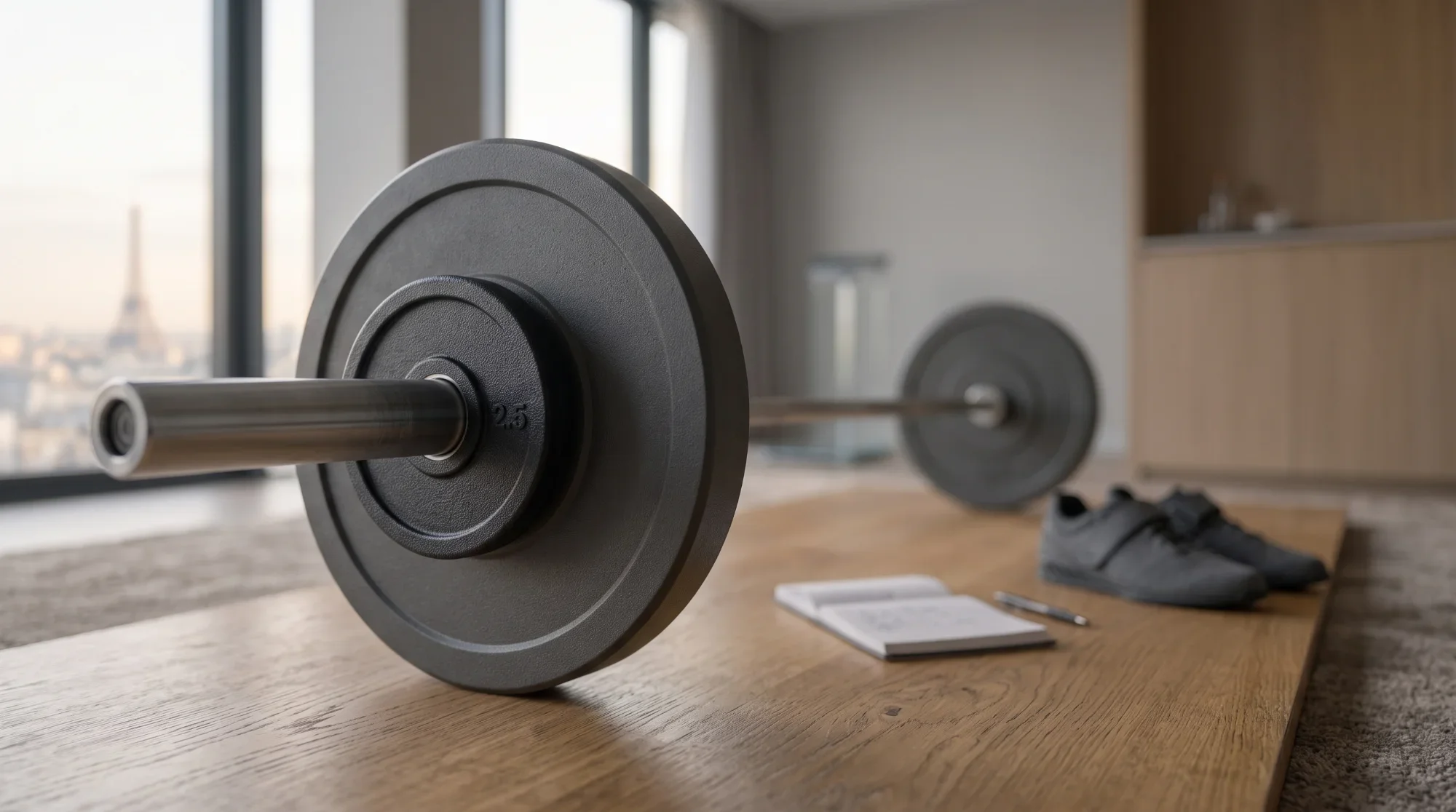
Progressive overload involves gradually increasing the difficulty of your workouts so that your body continues to adapt. Without progression, your body gets used to the routine and you stop seeing results. If you progress too quickly, you increase your risk of injury. The key is finding the right balance.
In a nutshell
- The idea is to push your body a little harder, on a regular basis, so it continues to improve.
- The key factors: load, repetitions, sets, form, rest, and frequency.
- A simple method: the double progression, with a range of repetitions.
- The safety measure: proper technique before increasing the load.
What is progressive overload?
This is the basic principle of strength training. When you ask a muscle to work a little harder than it’s used to, it adapts: it gets stronger. If the effort remains the same session after session, the adaptation stops. You must therefore gradually increase the demand.
This principle has long been recognized by sports organizations. The American College of Sports Medicine places it at the heart of its 2009 position statement on progression models in strength training.
How can I increase the difficulty?
Increasing the load isn't the only way. You can adjust six factors:
- The challenge: lift a little more weight.
- Repetitions: Add one or two repetitions with the same weight.
- Sets: Add a set to an exercise.
- Execution quality: better control of the movement, slow down the descent, increase the range of motion.
- Rest: Slightly reduce the rest time between sets.
- Frequency: Work a muscle one more time during the week.
The rule: change only one factor at a time. If everything changes at once, you won't know what's working or what's causing fatigue.
A Simple Method: Double Progression
The double progression is easy to follow, even on your own. Here's an example of an exercise consisting of 3 sets of 8 to 12 repetitions:
- Choose a weight that allows you to perform 8 clean repetitions in each set.
- At each workout, try to add one repetition without changing the weight.
- When you reach 12 repetitions across the 3 sets, using proper form, increase the weight slightly (by about 2 to 5 percent).
- Do 8 reps with the new weight, and then start over.
This method has one advantage: it tells you when to increase. You don't have to guess.
This principle can also be applied to other machines by gradually increasing the duration, speed, or resistance.
What do the guidelines say about volume and intensity?
The 2026 ACSM guidelines provide some useful guidelines. Training all major muscle groups at least twice a week is more important than following a complex program. For muscle gain, about 10 sets per week per muscle group is a good guideline. For strength, 2 to 3 sets per exercise with loads close to 80% of one’s maximum are recommended. Finally, training to muscle failure is not essential for overall health and fitness.
In other words, the increase doesn't have to be extreme. It just needs to be steady.
How often should I increase the amount?
There is no one-size-fits-all rule. You increase the weight when your form is consistent and you’ve reached your rep goal. Progress is never linear: a few weeks of plateauing are normal, especially after several months of training.
Taking it easy for one week every 4 to 8 weeks can help you recover and come back stronger.
The Most Common Mistakes
- Increasing the intensity too quickly. Tendons and joints adapt more slowly than muscles.
- Sacrificing form to lift heavier weights. A load that compromises your form is a risk, not progress. See our article in English, “Why Your Form Matters More Than Your Load.”
- Changing everything every week. Without a consistent point of reference, it's impossible to measure progress.
- Don't write anything down. Without a notebook, you'll forget what you spent last week.
- Neglecting recovery and sleep. It is during recovery that the body adapts.
How I Apply It with My Clients
I keep track of every session: exercises, weights, reps, and how I feel. I monitor my heart rate in real time, correct my form, and adjust the session based on how well I’ve recovered and slept that week. So your progress is based on how you’re feeling that day, not on a set schedule.
Here's an example: A client started doing machine crunches with sets of 20 repetitions at 80 kg. Nine months later, having progressed gradually, he was doing sets of 30 repetitions at 107.5 kg—the machine's maximum weight.
If you're looking for a program based on these principles, check out the strength training program.
What if I train on my own?
Grab a notebook or a note-taking app. For each exercise, write down the weight, the number of repetitions, and a difficulty rating on a scale of 1 to 10. Change only one variable at a time. If you hit a plateau that lasts more than 4 weeks, read our article on how to break through a plateau (in English).
Frequently Asked Questions
Should you increase the load at every workout?
No. Increasing the intensity at every session is only realistic at the very beginning. After that, progress is made in stages, over several weeks.
Can progressive overload be applied without equipment?
Yes. Add more repetitions, slow down the movement, switch to a one-leg or one-arm version, or reduce the hold times.
Is progressive overload suitable for women?
Yes, the principle is the same. For tips on building muscle tone without gaining bulk, see our article on how to build muscle without gaining bulk.
Is this suitable for people over 50?
Yes, with a more gradual progression and a greater focus on recovery. If you have a medical condition or are experiencing pain, consult a doctor first. See our guide to getting back into sports after age 50.
What should I do if I'm not making progress?
First, check your sleep, diet, and consistency. Then change just one factor: add one more set, one more rep, or a shorter rest period.
To learn more: sports coaching in Paris, a 60-minute personalized assessment, or contact me.
Sources
- American College of Sports Medicine, Position Statement 2026: Resistance Training Prescription for Muscle Function, Hypertrophy, and Physical Performance in Healthy Adults. https://acsm.org/resistance-training-guidelines-update-2026/
- American College of Sports Medicine, position statement: Progression models in resistance training for healthy adults, Medicine & Science in Sports & Exercise, 2009. https://pubmed.ncbi.nlm.nih.gov/19204579/
About the Author: Louis Fabre is a former tennis player (Roland Garros, NCAA Division I at Texas Tech) who holds dual master’s degrees in physical training and sports nutrition, with over 10 years of coaching experience and more than 2,000 clients.